Eddy NG
Build Plate Damage Alert
Your build plate must be spring steel with a magnetic sheet attached to your underlying printer bed. Do not try and use this probe with embedded magnets or some crappy magnetic flex plate that is not spring steel, your nozzle will dig a big hole in it.
This page covers installing SimpleAF using a BTT Eddy probe with eddy-ng firmware. New here? See Getting Started.
RPi / SBC users: install SimpleAF via SimpleAF for RPi. The rest of this page — probe firmware, mount options, and calibration — applies to your setup too.
Firmware requirements
Limits on X and Y microsteps
You cannot use more than microsteps: 32 for [stepper_x] and [stepper_y], the MCU cannot handle high microsteps, it puts too much pressure on the mainboard and it will cause stuttering and other reliability issues including random crashes.
Note
This limit generally does not apply to RPi Series Simple AF
K1 Series
This guide assumes you have a K1, K1C, K1SE or K1 Max and you are running stock creality firmware 1.3.3.5 or higher (The firmware 1.3.3.5 is much older than 1.3.3.46 for example), or alternately you can use my prerooted firmware.
Ender 5 Max
This probe is currently not supported on Ender 5 Max
Ender 3 V3 KE
This guide assumes you have a stock Ender 3 V3 KE with Nebula Pad with Root enabled, when you get to installation below, you should specify the --mount Default to install
Simple AF on the KE for Eddy-NG.
Please note that you will need to change the screen orientation to horizontal, here is a model for that https://www.printables.com/model/727362-ender-3-v3-ke-screen-holder-landscape-for-guppyscr, but please do not follow the installation instructions on that page, just print the model and remount your screen only! An alternative model which honestly seems a bit cleaner: https://www.printables.com/model/706657-creality-ender-3-v3-e3v3-se-ke-and-cr-10-se-portra
Nebula Pad
This probe is currently not supported on Nebula Pad, but support can be added if there is interest.
CR10SE
This probe is currently not supported on CR10SE, but support can be added if there is interest.
RPi or SBC
BTT Eddy Firmware
Warning
It is assumed that you have flashed your eddy with the firmware from https://github.com/pellcorp/klipper/blob/master/fw/K1/btteddy.uf2 before starting the installation!!!
For K1 Series Simple AF there is a guide
For Simple AF for RPi, you can follow this guide https://github.com/bigtreetech/Eddy?tab=readme-ov-file#compiling-firmware. But make sure
you are not trying to use any fork of klipper than pellcorp/klipper-rpi! You can also skip this compilation step and just copy
the ~/klipper/fw/k1/btteddy.uf2 file to the Eddy after putting it into boot mode.
Probe Installation
It is strongly recommended to connect your probe to the front USB port initially and use it for a while that way to make sure its stable, before directly wiring it to either the mainboard or making a cable for the lidar port (K1M users only). If possible avoid destroying the original cable when you are making your lidar or direct mainboard connection as you might need it in the future!
Danger
If you are not using a side mount you must verify config changes for eddyng.cfg before homing your printer, using Screws Tilt Calculate or doing a bed mesh!
Ignoring these instructions can lead to significant damage to your build plate and/or probe.
Mount Options
| Mount | Printer | URL | Notes |
|---|---|---|---|
| Default | K1, K1C, K1M, K1SE | https://www.printables.com/model/1012524-btteddy-creality-k1-k1c-k1-max-mount https://www.printables.com/model/1212731-btt-eddy_ng-mount-for-creality-k1-series |
|
| Pellcorp | K1, K1C, K1M, K1SE | https://www.printables.com/model/965667-wip-k1-btt-eddy-rear-mount-v4 | |
| Slam | K1, K1C, K1M, K1SE | https://www.printables.com/model/1195575-btt-eddy-mount-for-k1c | |
| Default | Ender 3 V3 SE | https://www.printables.com/model/1202031-ender-3-v3-se-k1-hotend-btt-eddy-mount | |
| Default | Ender 3 KE | https://www.printables.com/model/1002777-cr-touch-to-btt-eddy-adapter-bracket |
Nozzle Offset
Warning
The best success seems to be with the coil of a BTT Eddy mounted at about 2.95mm above the tip of the nozzle. This refers to the bottom of the coil PCB, not the bottom of the case.
For more specific information about this, see https://github.com/vvuk/eddy-ng/wiki/BTT-Eddy#probe-installation You can try this tool https://www.printables.com/model/1277844-btt-eddy-and-eddy-ng-setup-helpers
Installation
Warning
The installation section does not apply to Simple AF for RPi, See Simple AF for RPi
The installation can only be performed on a printer which has been rooted and ssh granted
You need root access, if you are not already root, then follow the Enable Root Access instructions.
Factory Reset
If you've installed Guilouz's Helper Script, or installed Fluidd or Mainsail through any other means (such as from Creality directly), you need to factory reset before continuing.
Clone the Repo
git config --global http.sslVerify false
git clone https://github.com/pellcorp/creality.git /usr/data/pellcorp
Note
If you had already cloned the pellcorp creality repository before being asked to factory reset, the git repo is still there and you can skip the cloning step!
Run the installer
Note
If you have pellcorp-overrides in github but not stored locally, you need to recreate the ~/pellcorp-overrides directory before running the installer.sh!
To run the script, you must specify the probe you want to use.
Warning
Replace Mount with the specific mount option for the mount you have used, if you do not do this the printer will be incorrectly configured for your mount, and bed meshes, x and y limits and related config will be wrong. Please refer to Mount Options for supported mounts.
If you are using a non-supported mount you should specify a mount option as close to your mount as possible and properly adjust your configuration after installation before trying to perform a bed mesh or Screws Tilt Calculate!
Post Installation
MCU Firmware updates are pending
At the end of the installer process if you get this message:
It means that new MCU firmware updates need to be applied and this can only be done by power cycling the printer. After your printer is power cycled you can verify firmware was updated with the CHECK_FIRMWARE macro from Fluidd or Mainsail, if you see this message:
Your printer MCU firmware was updated successfully. If you still see the MCU Firmware updates are pending you need to power cycle your printer! message after a power cycle, check the /tmp/mcu_update.log, you may be asked to provide this file on Discord if you need additional assistance, sometimes an additional power cycle can solve the problem, there is a very short window of time (15 seconds) in which the MCU firmware can be updated, so there is a chance it will work after an additional power cycle.
Slicer Settings
Calibration
Warning
The following calibration steps are required to setup a new printer:
Probe Eddy NG Setup
Note
The EddyNG guide recommends heating the bed before doing calibration
- Run
_SET_KIN_MAX_Zand then use normal controls to move the toolhead so that the nozzle is only a few mm above the bed surface - Run
M190 S60to heat the bed to 60c! - Run the
STOP_CAMERAmacro to stop the camera - Run
PROBE_EDDY_NG_SETUP, Follow the Paper Test Method
Upon completionSAVE_CONFIG
Warning
Do not use a metal feeler gauge for this step, it could damage your eddy!!!
Note
Is normal to show the Z position at almost at the max height of the printer even if the nozzle is somewhere in the middle or even close to the bed, this is not a bug, its intentional. Until this calibration step is completed, the Z axes cannot be homed, so we make the printer pretend the bed is down the bottom of the printer so that you can freely move the bed up to meet the nozzle during the paper test without running into out of range issues. You however won't be able to move the bed further away from the nozzle more than a few mm.
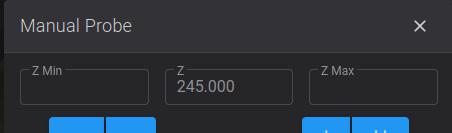
Source: https://github.com/vvuk/eddy-ng/wiki#calibration
Warning
If you get errors when it comes to tapping as part of printing you may need to increase the tap drive current
Manual Bed Tramming
To avoid the risk of bed damage due to a badly trammed bed, please perform Manual Bed Tramming before going any further.
Danger
You risk damage to your bed surface if the bed is significantly higher on one side compared to the centre of the bed where the printer is homed.
Pid Tuning and Input Shaping
At least PID tuning (bed and extruder) and input shaping is required for acceptable printing. If you try and print after running the installer.sh and a power cycle but before any calibration you will most likely have horrendous quality, the worst you have ever seen on the k1. After PID tuning and input shaping you should see the same kind of quality as you get with stock k1 + input shaper fix.
Note
You can use the QUICK_START Macro to complete Bed and Nozzle PID Tuning and Input Shaping Automatically.
Pid Tuning
Source: Calibrate Pid Settings
For example you might run these:
Note
The PID_CALIBRATE_BED and PID_CALIBRATE_HOTEND macros are located in the useful_macros.cfg file and they have defaults values for BED_TEMP and HOTEND_TEMP so you can just run them by clicking on them if you want that same temperature.
Input Shaping
There is no default configuration for input shaping so it is essentially disabled out of the box.
You can use the SHAPER_CALIBRATE macro to run input shaping, just be sure to SAVE CONFIG at the end, to choose the automatically selected shaper config, be aware though that the shaper chosen might be sub-optimal due to a slight difference in vibrations between two options. So you should probably review the output and potentially choose an alternative if it gives you higher recommended max acceleration for minimal increase in vibration.
Axis Twist Compensation
If you are using a rear mount it is highly recommended to perform axis twist compensation, this will affect the quality of your bed mesh, so best to do it before.
Tip
There is no need to run axis twist compensation if you have mounted the eddy with a side mount that has a 0 y offset!
- Home All (
G28) - Run
AXIS_TWIST_COMPENSATION_CALIBRATEThe calibration wizard will prompt you to measure the probe Z offset at a few points along the bed
Upon completionSAVE_CONFIG
Source: https://www.klipper3d.org/Axis_Twist_Compensation.html
First Print
You should optimise your probe z offset using baby stepping.
In fluidd the save button after you finish or cancel your print can be a bit hard to find, look for

Other Calibrations
Info
The default value for pressure advance is set to 0.04
Refer to Orcaslicer Calibration for more calibrations
Refer to the Ellis Print Tuning Guide for more great tuning ideas.
Where can I get help?
For support, join the SimpleAF Discord.
For questions about the upstream eddy-ng project itself, see: https://github.com/vvuk/eddy-ng/wiki#questions-discussion-help